

In one sentence
Type 1 wants things done properly, and carries an inner voice that checks every detail before signing off.
Core motivation
What drives a Type 1 is the need to act with integrity: to do things the right way, to be fair, and to look in the mirror without reproach. They are not chasing applause; they want the quiet of having met their own standard, which is almost always higher than any manager's or client's.
Their deepest fear is being careless, corrupt or unjust. So they live with an inner critic that comments on everything they do and is rarely satisfied. Much of what looks like perfectionism from the outside is really a way of quieting that voice: if the work comes out flawless, the criticism goes silent for a while.
How it shows up in remote work
In a remote admin or virtual-assistant role, the Type 1 is the person who leaves the CRM tidy, respects the agreed formats and catches the invoice error before the client does. They do their best work with clear processes and, where none exist, they build them: templates, checklists, file-naming rules. Their inbox is usually empty by the end of the day.
Their written communication is precise and a little formal. They would rather send a complete, correct message than a fast one, which can make them look slow in channels where everyone else replies in seconds. With clients they are reliable and direct: they find it hard to promise a deadline they are not sure they can keep, and that honesty is sometimes read as inflexibility.
They tend to underestimate how long their reviewing takes. Twenty minutes can go into polishing an email that was already fine. Feedback is taken seriously, perhaps too seriously: a minor correction can circle in their head for the rest of the day, long after everyone else has forgotten it.
Strengths
- Reliability: when they say it will be ready Thursday, it is ready Thursday.
- An eye for detail that prevents expensive mistakes in billing, contracts and client data.
- A sense of responsibility that does not depend on anyone watching.
- The ability to bring order to messy accounts and to improve processes nobody else had questioned.
Blind spots
- Rigidity: mistaking their way of doing things for the only correct way.
- Criticism that comes out unfiltered and lands as a rebuke, especially in writing.
- Trouble delegating, because checking someone else's work costs them more than doing it.
- Putting off rest until everything is perfect, which never happens.
Under stress
As pressure rises, the Type 1 becomes tighter and harsher. Comments turn into corrections, patience with other people's mistakes runs out, and a held-in irritation appears that everyone notices even if nobody names it. They may stay late fixing what others left half-done.
If the stress goes on, they can slide from demanding to feeling that nothing they do is ever enough. They turn more pessimistic, sadder and more withdrawn, and start comparing themselves with people who seem to work with less effort. That is a warning sign worth catching early.
At their best
At their best, Type 1s keep their standards but stop using them as a whip. They can tell what needs to be perfect from what only needs to be done, and they accept that a reasonable draft delivered on time is worth more than a flawless one delivered late.
They become a calm, wise presence on the team: the person who points out the problem evenly, proposes the fix and holds no grudge. A relaxed humor shows up that surprises people who only knew their demanding side.
Where this type moves
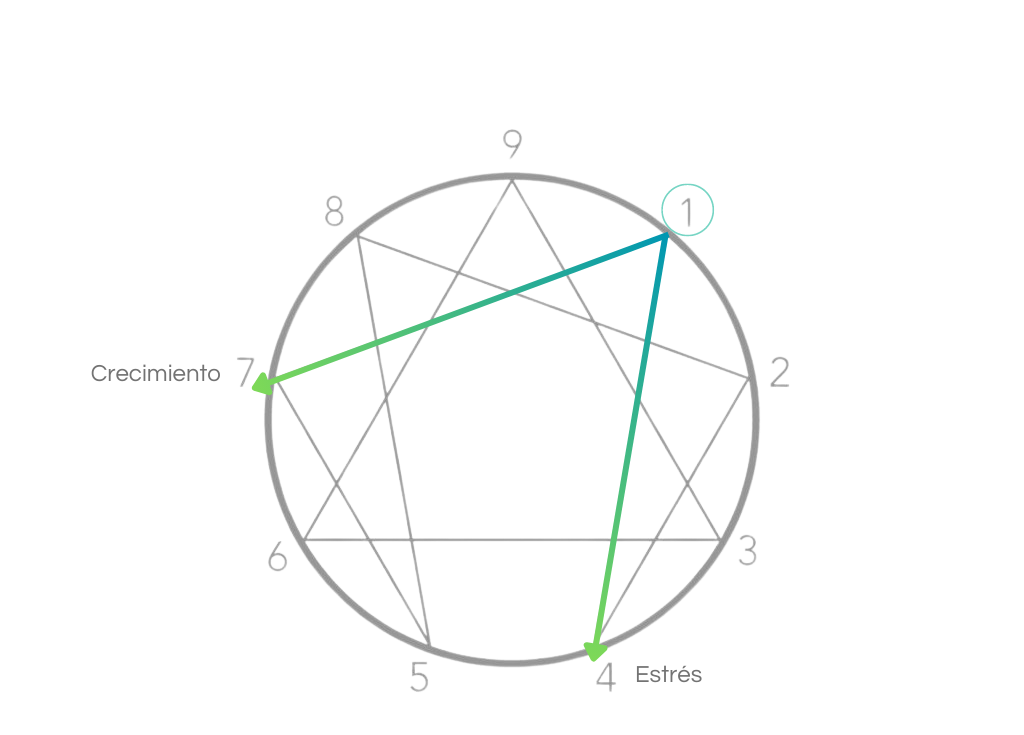
Under stress, toward Type 4 (The Individualist) — Under sustained stress, a Type 1 starts to look like a Type 4 on a bad day: self-criticism turns into gloom, they feel nobody values the effort they put into doing things properly, and they withdraw. If you catch yourself replaying a days-old mistake and feeling misunderstood by the team, that is the signal.
In growth, toward Type 7 (The Enthusiast) — When they feel secure, a 1 borrows the best of the 7: they let themselves enjoy the work, try things before they are perfect and get their sense of humor back. Work stops being an exam and goes back to being something they like doing; colleagues notice they correct less and propose more.
The two wings
Type 1 with a 9 wing — Slower-paced and more reserved. Corrects gently, prefers documenting to confronting and needs time alone to think. Well suited to sustained precision work.
Type 1 with a 2 wing — Warmer and more people-oriented. Wants to do things well and to help others do them well too, which pulls them naturally toward teaching processes and handling clients.
Types that get confused with this one
- Type 6 (The Loyalist) — Both are responsible and careful, but the 6 double-checks out of insecurity and looks for backing; the 1 double-checks on principle and trusts their own judgment.
- Type 3 (The Achiever) — Both work hard, but the 3 measures success by the visible result and the 1 by having done it the right way.
- Type 8 (The Challenger) — Both are direct and firm, but the 8 imposes their will and the 1 imposes a rule they believe applies to everyone, themselves included.
Growth practices
- Before sending a correction, ask what would change in the outcome if you skipped it. If the answer is nothing, skip it.
- Define in advance, in writing, what done means for each task. When you reach that point, hand it over even if the inner voice asks for one more pass.
- Schedule rest like a client appointment, with a start and an end time, and keep it with the same seriousness.
- When you notice irritation, name it privately before you write. A message sent from anger usually costs more time than it saves.
If you work with someone of this type
When you collaborate with a Type 1, agree on clear criteria and explain why priorities or plans change. Ambiguity can send their attention toward every possible flaw, while shared context helps them decide what truly matters. Invite questions early so precision becomes a shared resource rather than a private burden.
Offer feedback that is specific, proportionate and connected to the agreed goal. They may already notice the gap before anyone names it, so clarity is more useful than added intensity. Acknowledge careful contributions as well as corrections, and make room for good enough when further refinement no longer helps.
Frequently asked questions
Is Type 1 just a perfectionist?
Not quite. Perfectionism is the visible behavior; underneath it is a wish to do the right thing and a fear of failing at it. There are perfectionists of other types, and there are Type 1s who have learned to let go of the detail without losing the ethics that define them.
Which remote roles suit them best?
The ones that reward precision and consistency: account administration, billing, quality control, document management, support with defined processes. They also shine when creating and organizing procedures in teams that never had any.
How do I know I am a 1 and not a 6?
Ask yourself where the checking comes from. If you check because you are afraid something will go wrong and want to be covered, that sounds like a 6. If you check because handing in something with mistakes goes against who you are, and you would do it even if nobody would ever find out, that sounds like a 1.