
In one sentence
Type 6 anticipates what could go wrong and builds security for themselves and others, sometimes worrying more than needed.
Core motivation
What drives a Type 6 is the need to feel safe and backed up. They look for people, teams and systems they can trust, and when they find them they stay loyal for years. Their mind runs on scenarios: what if the client does not pay, if the server goes down, if the boss changes their mind. And they usually have a plan for each one.
Their deepest fear is being left without support or guidance, alone in front of a problem that is bigger than them. From that comes a constant vigilance that wears them out and sometimes turns into doubt: about other people, about decisions, about themselves. When they trust, that energy becomes a commitment that is hard to match.
How it shows up in remote work
In a remote operations, support, admin or executive-assistant role, the Type 6 is the one who has the backup done before anything fails, reads the fine print of the contract and flags the risk nobody else saw. They follow processes rigorously and, if there is a policy, they know it. Teams that have one sleep better.
Their communication is careful and seeks confirmation: they ask before assuming, request context and prefer to have agreements in writing. At a distance, unable to read the boss's face, they can take a silence for a problem. With clients they are responsible and honest; they promise what they can deliver, and deliver.
Over time they are steady, though they can spend hours checking and covering themselves before taking a step. They welcome feedback when it is clear; what unsettles them is ambiguity, messages that can be read two ways and changes without explanation. A good manager gives them certainty where possible and context where not.
Strengths
- Reliability and loyalty: they stay when others leave, and they keep their word.
- An eye for risk that prevents problems before they happen.
- Team spirit: they work for the group and protect their colleagues.
- Meticulous preparation for meetings, deliveries and difficult situations.
Blind spots
- Second-guessing decisions already made and reopening them, which slows the team down.
- Reading silences and delays as danger signals.
- Staying loyal to a boss, client or process that no longer deserves it.
- Worry is contagious: their anxiety raises the alert level of the whole chat.
Under stress
Under pressure, the Type 6 asks more, checks more and trusts less. They seek repeated confirmation, look for allies to validate their decisions and can turn reactive, arguing over changes they would otherwise accept without fuss. Sometimes they do the opposite: face the fear head-on and become defiant.
If the stress goes on, they start to look like someone trying to impress: more competitive, hiding their doubts behind a front of confidence, worried about how they are seen. That is the sign they have lost the ground that held them, and the way out is not more pressure but more clarity.
At their best
At their best, Type 6s trust their own judgment as much as they trust other people's. They make decisions without asking for three confirmations, tell real risk from imagined risk, and use their gift for anticipation to prevent rather than to worry.
They become a brave, steady presence, the person the team turns to when things get complicated. Their loyalty becomes freer: they choose whom and what to commit to, and that is why their commitment is worth more.
Where this type moves
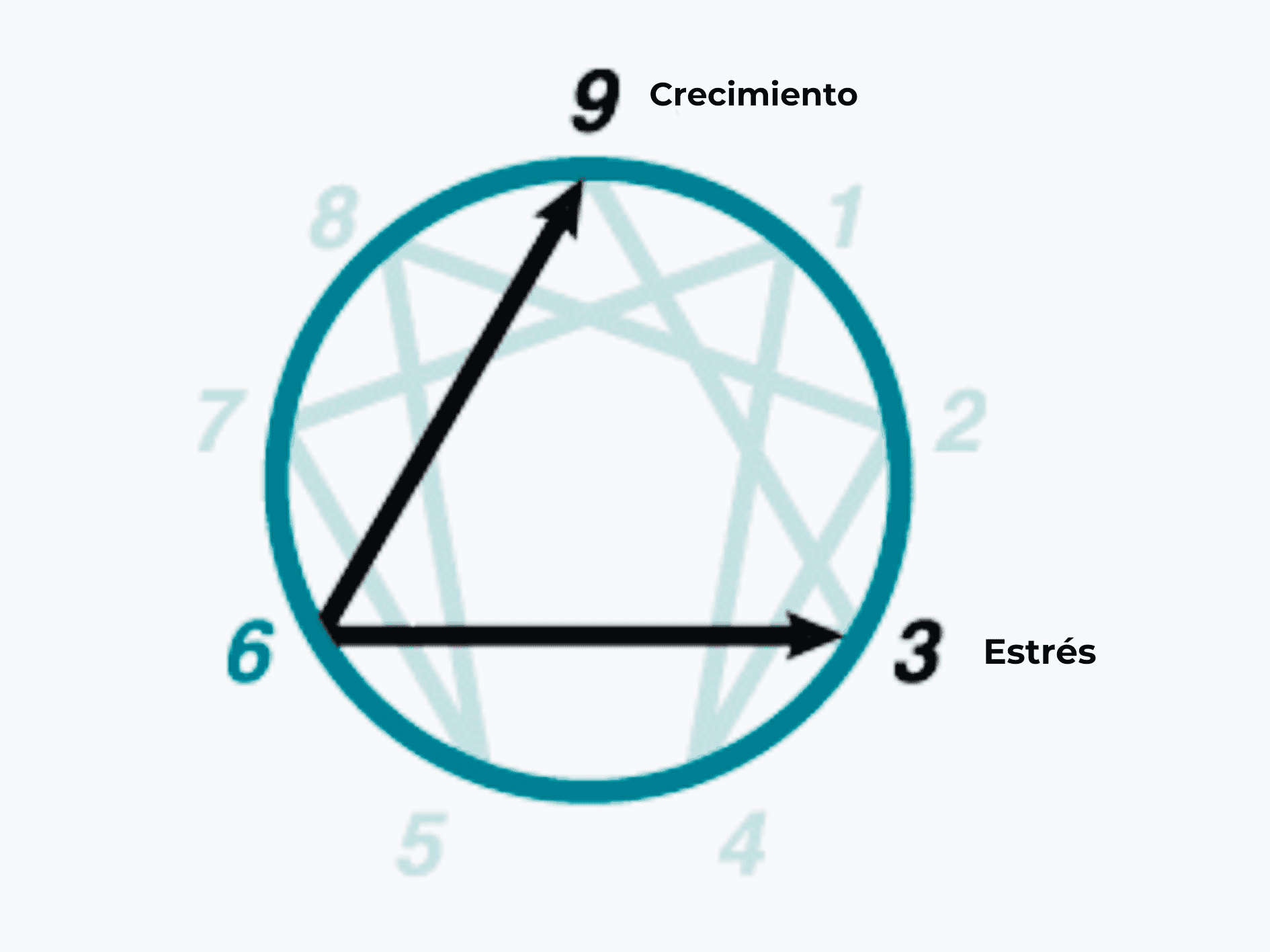
Under stress, toward Type 3 (The Achiever) — Under pressure, a Type 6 becomes a 3 at its worst: working non-stop to cover the anxiety, trying to look competent instead of feeling secure, and promising more than they can deliver. The overactivity is the tell: the more fear, the busier they get.
In growth, toward Type 9 (The Peacemaker) — When they feel secure, a 6 gains the calm of the 9: they trust their own judgment, stop seeking sign-off for every step and accept that not everything that could go wrong will. They are still the person who sees the risks, but now they look at them steadily and decide.
The two wings
Type 6 with a 5 wing — More reserved and analytical. Manages uncertainty by studying: gathers data, reads documentation and prefers to work alone on complex problems. Does well in technical and control roles.
Type 6 with a 7 wing — More sociable and optimistic. Manages uncertainty in company: talks, asks and looks for allies. Does well in customer support and in teams where energy counts.
Types that get confused with this one
- Type 1 (The Reformer) — Both are responsible and careful, but the 1 checks on principle and the 6 checks for safety.
- Type 2 (The Helper) — Both are loyal and attentive, but the 2 seeks affection from people and the 6 seeks backing from the group.
- Type 9 (The Peacemaker) — Both value stability, but the 9 gets it by avoiding conflict and the 6 by preparing for it.
Growth practices
- When a worry shows up, write down the real probability that it happens and what you would do if it did. It is usually less than it seems.
- Make one small decision a day without consulting anyone, and note how it went. Build up evidence that your judgment works.
- When the boss or the client goes quiet, wait a day before interpreting it. If it continues, ask directly.
- Choose one trusted person to review important decisions with, and only one.
If you work with someone of this type
When you collaborate with a Type 6, make expectations explicit and explain the reason for changes. Answer questions without treating them as resistance; testing a plan can be their way of building trust. Confirm decisions and follow through, because consistency carries more weight than reassurance that is not backed by action.
Listen carefully when they raise risks, while helping distinguish a concrete problem from a possibility that needs no immediate response. Invite disagreement before it turns into private worry. Small signals of reliability, including acknowledging a message and naming the next step, help the relationship feel solid enough for honest participation.
Frequently asked questions
Is Type 6 a fearful person?
They are alert to risk, which is not the same thing. Many Type 6s are among the bravest people in a crisis, precisely because they have spent years imagining how to act in one. The fear shows more in everyday doubt than in emergencies.
Which remote roles suit them best?
Operations, support, administration, compliance, risk management and executive assistance. Any role where foresight, loyalty and process discipline are an advantage. They do worse in chaotic settings without clear rules.
How is it different from Type 1?
Both check a lot, but the 1 checks because they have an inner standard and trust it; the 6 checks because they fear something will fail and looks for outside confirmation. The 1 corrects others; the 6 wonders whether they themselves are doing it right.