

In one sentence
Type 3 turns any task into a goal, and does not stop until the result is something they can show.
Core motivation
What drives a Type 3 is the wish to be valued for what they achieve. They learned early that results bring recognition, and since then they have organized their energy around concrete targets: close the sale, deliver ahead of time, beat this month's number. They are efficient because efficiency is the most direct way to earn a place.
Their deepest fear is being seen as worthless, a failure, someone not worth the trouble. So they adapt their image to whatever each setting rewards, and they do it so well that they sometimes lose sight of what they themselves want, beyond what looks good. Success calms that fear for a while; the next target wakes it up again.
How it shows up in remote work
In a remote sales, account-management or project-coordination role, the Type 3 is the one whose dashboard is up to date, who answers the client within minutes and who presents the weekly report with charts nobody asked for but everyone appreciates. They work fast, prioritize without drama and do not need supervision to keep moving.
Their communication is clear, positive and action-oriented. They prefer short messages with next steps, and on video calls they project confidence even when tired. With clients they are persuasive and adaptable: by the first meeting they know which version of themselves works best with each one.
With time they are demanding: they fill their calendar and treat rest as a waste. They take feedback pragmatically when it comes with data, but a criticism that touches their image or hints they are underperforming is very hard to hear. And they can dress up a weak result with a brilliant presentation, never quite lying but not telling everything either.
Strengths
- Sustained productivity: they finish tasks, not just start them.
- Adaptability across different clients and teams without losing effectiveness.
- Clarity in setting goals and measuring progress, which brings order to the whole team.
- Contagious energy that lifts the pace of a remote group that had stalled.
Blind spots
- Confusing being busy with being valuable, and not knowing how to stop.
- Putting how the work looks ahead of whether it is done well.
- Impatience with slow processes or with people who do not share their pace.
- Disconnecting from their feelings until exhaustion collects all at once.
Under stress
Under pressure, the Type 3 speeds up. They work more hours, take on more projects and become more competitive, even with their own teammates. A certain coldness shows: conversations shrink to logistics, and other people's mistakes irritate them because they slow the result.
If the pressure does not ease, they can disengage from work in a way that is unlike them: procrastinating, drifting, leaving tasks half-done and wondering what all the effort was for. It is a silent collapse, because until then everything seemed to be working. Their manager usually finds out late.
At their best
At their best, Type 3s are still effective but stop performing. They show what they really think even when it is not polished, celebrate other people's wins with the same energy as their own, and use their talent to make the whole team stand out, not only themselves.
They learn to value the process as well as the result, and to rest without guilt. They become an authentic, generous person who inspires because they are real, not because they have the best numbers. And they discover that people value them just as much when they are not producing.
Where this type moves
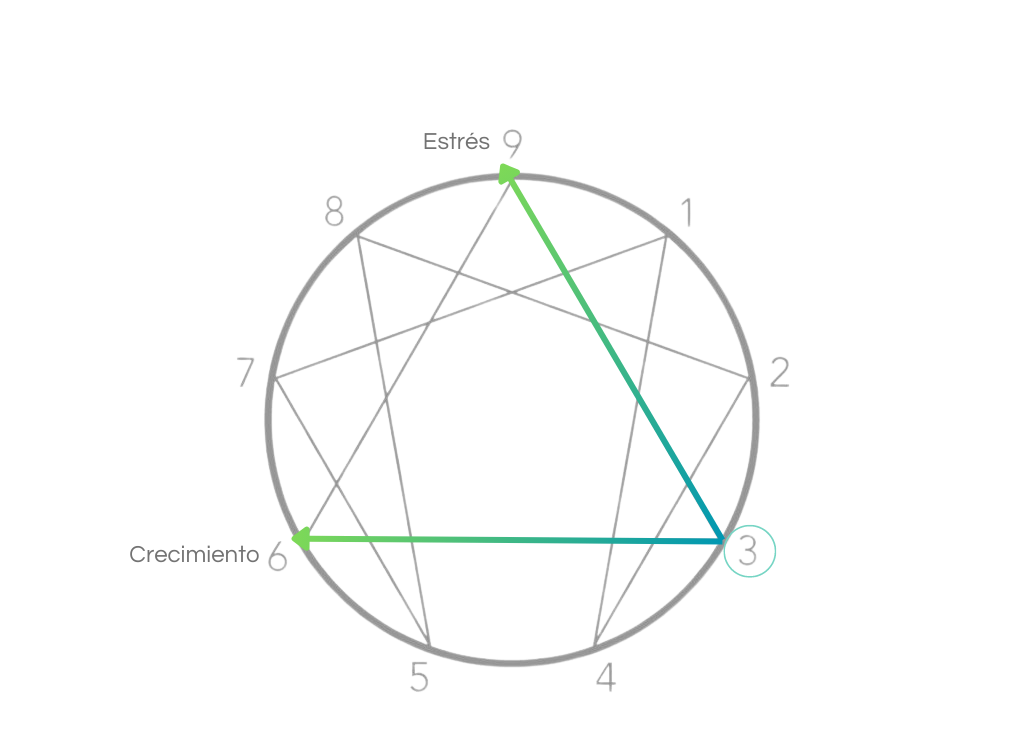
Under stress, toward Type 9 (The Peacemaker) — Under stress, a Type 3 does not speed up; they switch off like a 9 in a slump. Focus goes, tasks slip, small jobs become a refuge and the conversations that decide whether a project moves get avoided. From outside it looks like calm; inside it is the feeling that no result is ever enough.
In growth, toward Type 6 (The Loyalist) — When they feel secure, a 3 takes on the best of the 6: loyalty to the team over their own image. They share credit, say “I don't know” without flinching and work toward goals that do not carry their name. The ambition is still there, but someone other than themselves is now at the center of it.
The two wings
Type 3 with a 2 wing — Warmer and more people-oriented. Their achievements run through relationships: they look after the client, motivate the team and know how to make others feel part of the success.
Type 3 with a 4 wing — More reserved and harder on themselves. They care that the work has quality and a personal stamp, not only that it looks good. They tend to prefer projects where their judgment can stand out.
Types that get confused with this one
- Type 1 (The Reformer) — Both work hard, but the 1 wants it done correctly and the 3 wants it to deliver and be noticed.
- Type 7 (The Enthusiast) — Both are fast and optimistic, but the 7 chases variety and the 3 chases goals.
- Type 8 (The Challenger) — Both are decisive, but the 8 wants control and the 3 wants recognition; the 8 confronts, the 3 adapts.
Growth practices
- Once a week, tell someone you trust about something that did not go well, without dressing it up. Notice that the relationship does not change.
- Block time in your calendar with no objective and protect it as if it were a meeting with your most important client.
- Before answering a criticism, ask what it says about the work rather than about your image. Respond only to the former.
- Practice recognizing a teammate's achievement in public at least once a week.
If you work with someone of this type
When you collaborate with a Type 3, define the shared goal and what complete means before momentum takes over. Discuss progress, tradeoffs and obstacles with the same directness as visible results. Ask how the pace is affecting them, then leave enough silence for an answer that is more honest than an automatic fine.
Recognize effort, learning and integrity, not only polished outcomes. When speed begins to outrun detail, return to the agreement without shaming their ambition. A relationship where unfinished questions can be named openly helps them contribute with energy while staying connected to themselves and to everyone involved.
Frequently asked questions
Is Type 3 superficial?
No. They are adaptable, and that adaptability can look like a lack of depth. Underneath is a person with intense feelings who learned to put them off until later. When they trust you, they show far more than their image suggests.
Which remote roles suit them best?
Sales, business development, account management, project coordination and any role with measurable goals and visibility. They wither in routine roles with no targets and no recognition.
How do I know whether I am a 3 or a 1?
Ask which hurts more: handing in something with mistakes, or handing in something nobody notices. If the first, that sounds like a 1. If the second, and you also adjust your style depending on who is watching, that sounds like a 3.