

In one sentence
Type 8 takes charge when nobody else does, says what they think and protects the people they consider their own.
Core motivation
What drives a Type 8 is the need to be strong and in control of their own life. They cannot stand feeling at other people's mercy, so they would rather decide, move and take responsibility than wait for instructions. They respect people who speak to them straight and distrust anyone who goes around the point.
Their deepest fear is being controlled, betrayed or vulnerable to someone who would take advantage. From that comes a shell of firmness that makes it hard to see the loyalty and tenderness underneath. Much of their toughness is not aggression but the way they learned to keep anyone from walking over them or their people.
How it shows up in remote work
In a remote operations, team-lead, sales or project-coordination role, the Type 8 is the one who makes the decision that was stuck, negotiates with the difficult vendor and stands up for the team against a client who crosses the line. Distance does not shrink their presence: the chat notices when they arrive.
Their communication is direct, brief and unadorned. They get to the point, ask for what they need and expect the same. In writing, that frankness can read as bluntness, especially to colleagues of more sensitive types. With clients they are firm and dependable: they do not promise what they cannot deliver and do not accept abusive terms.
Over time they are effective and decisive, though they may steamroll processes they consider slow. They accept feedback from someone they respect, as long as it is honest; softened or indirect messages make them more suspicious than a hard criticism would. They need to know their manager has a mind of their own.
Strengths
- Decisiveness: they unblock situations that had been stuck for weeks.
- Protection of the team, which turns into loyalty and people who stay.
- Frankness that saves time and misunderstandings.
- Resilience under pressure and the ability to hold difficult conversations.
Blind spots
- Intimidating without realizing it, so people stop telling them what they think.
- Confusing firmness with always being right.
- Trouble letting go of control and accepting other people's decisions.
- Ignoring their own exhaustion and everyone else's until someone breaks.
Under stress
Under pressure, the Type 8 turns up the volume. They become more domineering, more impatient and more confrontational, and can make unilateral decisions that leave the team out. They suspect other people's motives and look for who is against them. In a chat, their messages get shorter and harder.
If the stress continues, a withdrawal appears that is unlike them: they isolate, stop fighting, go quieter and more reserved, and can seem to have lost interest. That is the sign they felt overwhelmed and do not want anyone to see it. People who know them know that silence is more worrying than any outburst.
At their best
At their best, Type 8s use their strength to make room for others, not to fill all of it. They listen before deciding, admit when they are wrong and let their team shine. They discover that showing vulnerability does not take away their authority; it gives it to them.
They become a generous, fair leader, the person people follow out of conviction rather than fear. Their energy goes into something bigger than themselves, and that is where they go furthest.
Where this type moves
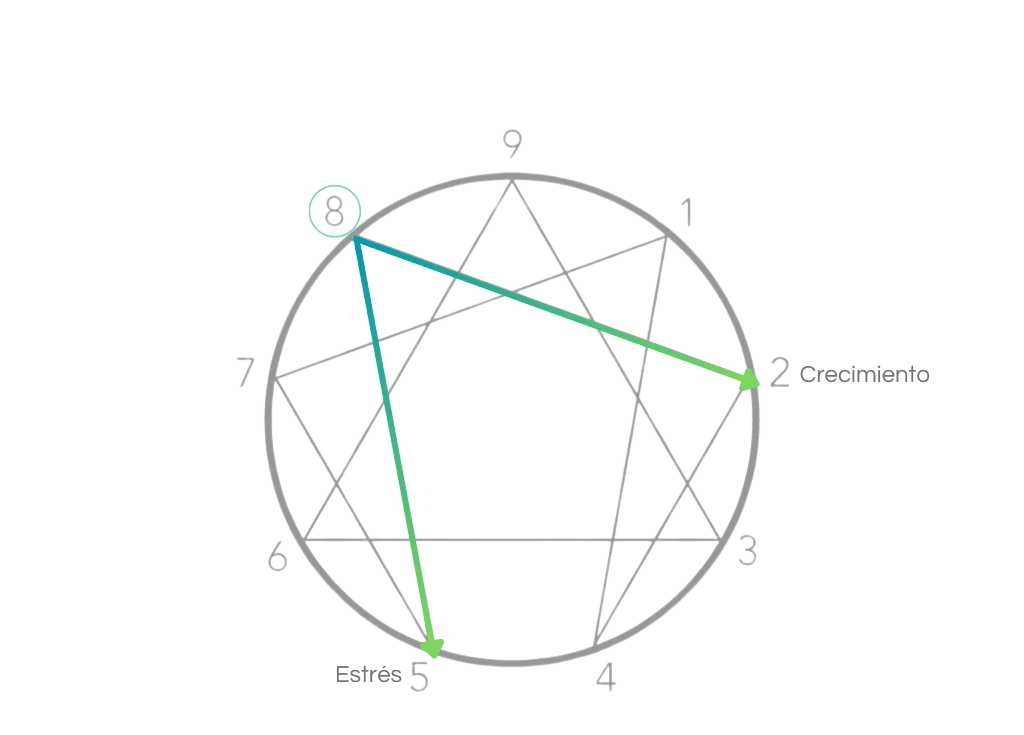
Under stress, toward Type 5 (The Investigator) — Under sustained stress, a Type 8 pulls back like a 5 in a slump: they isolate, go quiet, distrust everyone and hoard information as if it were the last defense they have. The person who filled the chat suddenly disappears, and the team feels it.
In growth, toward Type 2 (The Helper) — When they feel secure, an 8 shows the best of the 2: they use their strength to look after people, not to dominate them. They ask how someone is doing and listen to the answer, protect without controlling and let it show that they need others too. Authority does not drop; it becomes easier to follow.
The two wings
Type 8 with a 7 wing — More outgoing, fast and entrepreneurial. Combines strength with enthusiasm and tends to create opportunities where there were none. Does well in sales and new ventures.
Type 8 with a 9 wing — Calmer and more patient. Their strength is quiet: they do not need to raise their voice to be heard. Does well leading teams and mediating negotiations.
Types that get confused with this one
- Type 1 (The Reformer) — Both are direct and firm, but the 1 imposes a rule and the 8 imposes their will; the 1 holds back, the 8 lets it out.
- Type 3 (The Achiever) — Both are decisive, but the 3 adapts to win recognition and the 8 confronts to keep control.
- Type 6 (The Loyalist) — Both can turn defiant, but the 6 does it from fear and in bursts; the 8 does it from confidence and consistently.
Growth practices
- In every meeting, ask the quietest person's opinion before giving your own.
- When you write a message in anger, save it as a draft and reread it an hour later before sending.
- Delegate one complete decision a week and do not review it: accept the result as it comes.
- Practice saying out loud, to someone you trust, that you are tired or that something got to you. Notice that nothing bad happens.
If you work with someone of this type
When you collaborate with a Type 8, speak plainly, keep commitments and address tension directly. Set clear boundaries in both directions instead of relying on hints or avoiding a difficult subject. They often respond better to an honest disagreement than to apparent agreement that disappears later.
Make room for perspectives expressed with less force, and do not let every difference become a test of strength. Discuss impact as openly as intent, preferably away from an audience when the subject is sensitive. Mutual respect grows when candour, accountability and the option to change one's mind apply to everyone.
Frequently asked questions
Is Type 8 aggressive?
They are direct and intense, which is not the same thing. Most Type 8s are not looking for a fight; they want things to move and nobody to be taken advantage of. When the environment is honest and respectful, their strength becomes protection, not attack.
Which remote roles suit them best?
Team leadership, operations management, sales, vendor negotiation and any role with real autonomy and decisions to make. They do worse under constant supervision or in positions where they cannot influence anything.
How do I know whether I am an 8 or a 1?
Ask what makes you angry. If it is things not being done properly, and you hold the anger in so as not to seem unfair, that sounds like a 1. If it is someone trying to control you or walk over your people, and the anger comes out unfiltered, that sounds like an 8.