

In one sentence
Type 5 needs to understand thoroughly before acting, and guards their time and energy as scarce resources.
Core motivation
What drives a Type 5 is the wish to be competent and to understand how things work. They would rather observe than take part, and they gather knowledge as if it were the only safe way to face the world. They like to master a subject down to the detail and feel at peace when they have a clear system in their head.
Their deepest fear is being useless or overwhelmed: that the world will ask more of them than they have to give. So they manage their energy carefully, limit commitments and put distance between themselves and anything that feels too demanding. What looks like coldness from the outside is usually, on the inside, a way of not running dry.
How it shows up in remote work
In a remote data-analysis, technical-support, research or systems-administration role, the Type 5 is the person who understands how the whole process is put together, finds the root cause of the error others keep patching, and documents what they learned without being asked. Remote work suits them: fewer interruptions, more focus.
Their communication is terse and precise. They prefer text to video calls, and one well-considered message to ten quick ones. They answer what was asked and add no filler, which can read as distance. With clients they are objective and calm, though the emotional side of a complaint costs them more than the technical side.
Over time they are disciplined, but they can keep researching longer than needed before delivering, because there is always one more fact missing. They process feedback in silence; they do not react in the moment and may seem not to care, when in fact they are analyzing it in detail.
Strengths
- Depth of analysis: they get to the cause, not the symptom.
- Real autonomy; they need neither supervision nor external motivation to keep going.
- Calm under technical pressure, when everyone else panics.
- Clear documentation and systems that the team inherits and is grateful for.
Blind spots
- Over-researching and delivering late, waiting to have all the information.
- Disappearing from the channels while concentrating, so the team does not know what they are on.
- Struggling with routine human contact: the greeting, the small talk, the team meeting.
- Confusing knowing with doing; sometimes learning stands in for action.
Under stress
Under pressure, the Type 5 withdraws. They cut contact to a minimum, answer in monosyllables and take refuge in the technical task. They can turn curt with whoever interrupts them and rationalize everything, including what affects them emotionally. The team feels a door has closed.
If the stress continues, a scatteredness appears that is unlike them: they jump between topics, fill up on stimulation and activity to avoid feeling the pressure, and lose the focus that defines them. That is the sign they are at the limit of their energy and need fewer demands, not a faster pace.
At their best
At their best, Type 5s share what they know instead of hoarding it. They take part in team conversations, patiently explain what is obvious to them, and deliver before they have the full picture, because they have understood that information also arrives through doing.
They become lucid and generous, able to see patterns nobody else sees and to put them in service of a shared goal. They trust that their energy is renewed through contact with others and not only in solitude, and that makes them more present and lighter.
Where this type moves
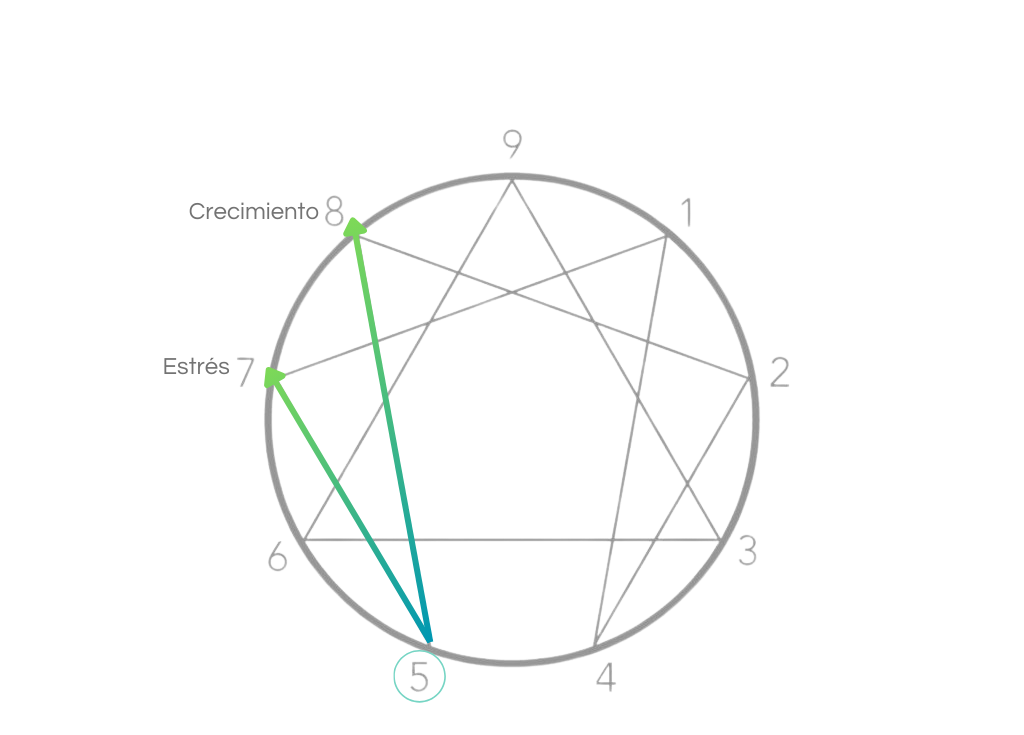
Under stress, toward Type 7 (The Enthusiast) — Under stress, a Type 5 scatters like a 7 in a slump: jumping between ideas, piling up tabs and half-finished projects, filling the silence with activity so as not to feel their resources running out. The mind stays fast but stops landing on anything.
In growth, toward Type 8 (The Challenger) — When they feel secure, a 5 takes on the strength of the 8: they step out of observation and act. They give an opinion before it is fully proven, take up their space in a meeting and back a decision with presence, not only data. They find that getting involved does not drain them; it connects them.
The two wings
Type 5 with a 4 wing — More creative and sensitive. Combines analysis with a personal point of view, and tends to be drawn to unconventional subjects. Works best alone and with freedom of approach.
Type 5 with a 6 wing — More practical and team-oriented. Applies what they know to concrete problems, values procedures and is comfortable as a group's go-to specialist.
Types that get confused with this one
- Type 9 (The Peacemaker) — Both are reserved and avoid drama, but the 9 withdraws to keep the peace and the 5 to conserve energy and understand.
- Type 1 (The Reformer) — Both are rigorous, but the 1 wants things done right and the 5 wants to understand why they work.
- Type 4 (The Individualist) — Both seek depth, but the 4 looks for it in feelings and the 5 in ideas.
Growth practices
- Set a time cap for research before delivering. When it runs out, hand over what you have with a note on what is missing.
- Post a short status message in the team channel every morning, even if nobody asks. It is the minimum presence that prevents misunderstandings.
- Accept one meeting a week that is not strictly necessary, and stay until the end.
- When someone brings you a problem, respond to the person first and the problem second.
If you work with someone of this type
When you collaborate with a Type 5, share context and questions in advance when possible, protect periods of concentration and agree on response times. Do not interpret quiet processing as indifference or require visible enthusiasm as proof of care. Predictable communication makes participation less draining and more substantive.
Invite their perspective without putting them on the spot, and be specific about what decision the conversation needs. Agree on the point at which enough information is enough, since open-ended inquiry can keep expanding. Respect privacy while also naming when others need an update, a question or a clear conclusion.
Frequently asked questions
Is Type 5 antisocial?
No. They are selective with their energy. They enjoy conversations with substance and relationships built on trust; what costs them is constant, shallow interaction. In a remote team that respects their time they tend to be a very loyal collaborator.
Which remote roles suit them best?
Data analysis, technical support, research, documentation, systems administration and any work that rewards depth over response speed. They do worse in roles with continuous emotional contact or permanent interruptions.
How do I know whether I am a 5 or a 9?
Ask what you withdraw for. If it is to avoid conflict and keep things calm with others, that sounds like a 9. If it is to think, understand and save energy, and conflict does not actually bother you as long as it stays rational, that sounds like a 5.