

In one sentence
Type 9 keeps calm and harmony around them, sometimes at the cost of forgetting what they themselves want.
Core motivation
What drives a Type 9 is the wish for peace: inside, with other people and in their surroundings. They listen without judging, understand every point of view and have a natural gift for making people feel at ease. They would rather things flow than be forced, and they are usually the steadiest person on any team.
Their deepest fear is conflict and disconnection: that an argument will break a bond, or that their presence will be a problem for someone. So they tend to give way, put off what is uncomfortable and keep their preferences to themselves. What looks like calm is sometimes a way of not making waves, even when it costs them dearly.
How it shows up in remote work
In a remote support, admin, coordination or customer-service role, the Type 9 is the one who handles the furious client without getting rattled, mediates between two colleagues who exchanged tense messages and keeps the pace when everyone else is stressed. They work well with familiar routines and in teams where the climate is kind.
Their communication is calm and conciliatory. They listen more than they talk, avoid a sharp tone and look for agreement. At a distance, that can turn into invisibility: they do not interrupt, ask or complain, and the team can forget they are there. With clients they are patient and warm, though delivering bad news or saying no is hard for them.
Over time they are steady, but they can drift into secondary tasks to avoid the one that matters most. They take feedback without defending themselves, and that is the risk: they may nod and change nothing, or keep a disagreement to themselves that surfaces weeks later as passive resistance.
Strengths
- A calm that lowers the tension of any conversation, with clients or inside the team.
- The ability to listen and to understand opposing positions without taking sides.
- Steadiness and reliability in long-haul tasks.
- Ease in fitting into diverse teams and helping them work together.
Blind spots
- Putting off what matters and taking refuge in what is comfortable.
- Not voicing disagreement, then showing it as delay or silence.
- Forgetting their own priorities to fit in with everyone else's.
- Seeming not to care either way, when really they do not dare to choose.
Under stress
Under pressure, the Type 9 checks out. They reply more slowly, get lost in minor tasks, avoid the hard meetings and seem absent even when online. They can turn quietly stubborn: they do not argue, but they do not do what was asked either. The team notices something has switched off.
If the stress continues, a worry appears that is not natural to them: they doubt everything, imagine negative scenarios and look for reassurance from others with a visible anxiety. That is the sign they have been silent about what is going on for too long and need to talk about it before it turns into paralysis.
At their best
At their best, Type 9s keep their serenity but gain presence. They say what they think in time, choose their priorities and stand by them, and use their gift for mediation to resolve conflicts rather than avoid them.
They become a person with a quiet strength that others recognize: firm without being hard, present without needing the spotlight. They discover that their opinion matters, and that voicing it does not break the peace but makes it real.
Where this type moves
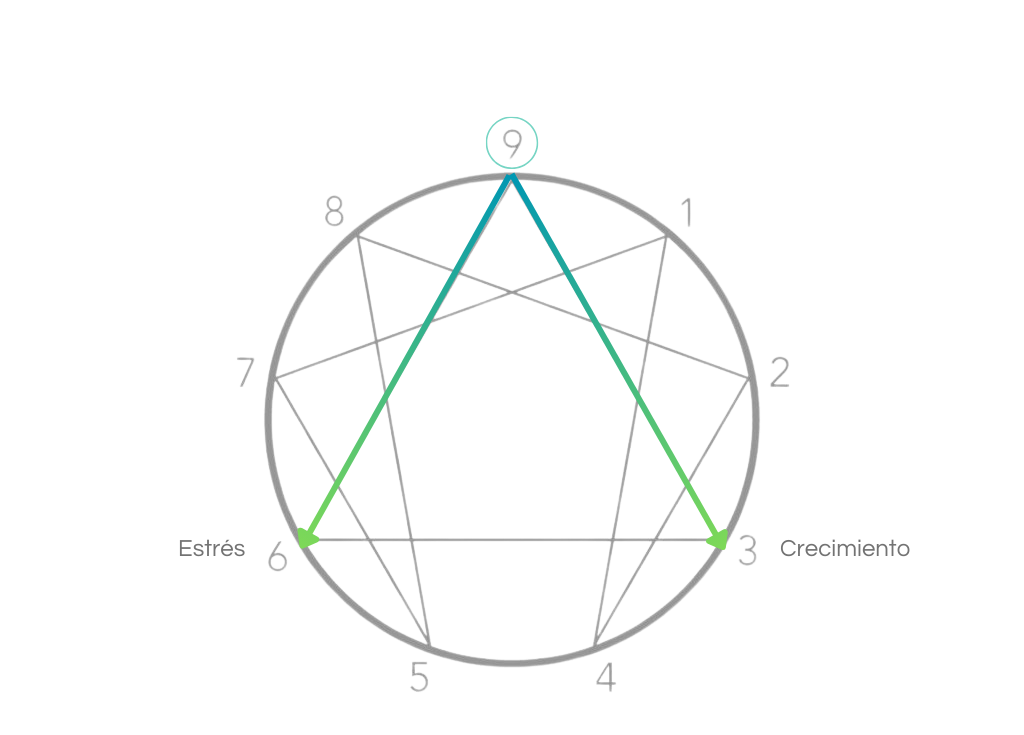
Under stress, toward Type 6 (The Loyalist) — Under pressure, a Type 9 turns anxious like a 6 in a slump: doubting everything, imagining what could go wrong, asking for reassurance and freezing between options. The usual calm becomes a back-and-forth that never reaches a decision, and the tasks pile up.
In growth, toward Type 3 (The Achiever) — When they feel secure, a 9 takes on the energy of the 3: they set goals of their own, say them out loud and go after them. They stop fitting themselves around everyone else's agenda, prioritize and finish. They find that having a clear opinion does not break the team's peace; more often it settles it.
The two wings
Type 9 with an 8 wing — Firmer and more energetic. When something matters to them, they can dig in and defend it with a determination that surprises people. Does well in coordination and in roles with some negotiation.
Type 9 with a 1 wing — More orderly and with a stronger sense of duty. Combines calm with responsibility and cares about doing things properly. Does well in administration and in processes that need care.
Types that get confused with this one
- Type 2 (The Helper) — Both are kind and give way easily, but the 2 moves closer to be needed and the 9 accommodates so as not to disturb.
- Type 5 (The Investigator) — Both are reserved, but the 5 withdraws to think and save energy, and the 9 withdraws to avoid tension.
- Type 6 (The Loyalist) — Both value stability, but the 6 prepares for conflict and the 9 avoids it; the 6 doubts out loud, the 9 in silence.
Growth practices
- Start every day with the task that makes you most uncomfortable, before opening email.
- In every meeting, state at least one opinion of your own, even if it matches someone else's. What matters is that you are the one saying it.
- When someone asks you for something, answer with what you would prefer before agreeing. Practice with small decisions.
- If you notice you are stalling on something you agreed to, say it plainly: I would rather not, or I need more time.
If you work with someone of this type
When you collaborate with a Type 9, ask directly for their view and wait long enough to hear it; calm does not necessarily mean agreement. Make priorities explicit and check shared understanding instead of assuming silence is consent. Advance notice of changes gives them time to find and express their own position.
Surface tension early and gently so keeping the peace does not require anyone to disappear. Confirm what has been decided, invite the difficult answer by name and acknowledge the steadiness they bring without making it their duty to soothe everyone else. Their needs belong in the conversation as much as the group's comfort.
Frequently asked questions
Is Type 9 a passive person?
Not necessarily. They avoid conflict, and that can look like passivity. When something truly matters to them, many Type 9s show remarkable determination. The key is helping them find out what matters.
Which remote roles suit them best?
Customer service, support, administration, team coordination and mediation. Any role where calm, listening and steadiness are an advantage. They do worse in aggressive settings or under constant pressure to decide fast.
How do I know whether I am a 9 or a 2?
Ask what you do when someone is upset with you. If you move closer to fix it and to show you are valuable, that sounds like a 2. If you move away, wait for it to pass and would rather not talk about it, that sounds like a 9.