


Every HR leader and business owner knows the sting of a bad hire. But when it comes to remote roles, the damage runs deeper than a line item on a spreadsheet. It hides in Slack threads, missed deadlines, founder bottlenecks, and endless rework cycles that quietly erode your team's momentum.
The good news? Most of this is preventable — if you know where to look.
Why the "Cost of a Bad Hire" Statistic Doesn't Tell the Whole Story
You've probably heard the figure: a bad hire can cost anywhere from 30% to 150% of that employee's annual salary, according to estimates from SHRM and the U.S. Department of Labor. For a $60,000 remote role, that's potentially $90,000 in direct and indirect losses.
But here's what those statistics miss: the operational cost.
When a remote hire doesn't work out, you're not just losing money on recruiting fees and onboarding time. You're losing:
- Weeks or months of delayed execution on projects that were supposed to move the needle
- Founder or manager time spent micromanaging, re-explaining, and course-correcting
- Team morale and cohesion, especially when friction spreads across time zones
- Opportunity cost — the work that didn't get done while you were managing the problem
For U.S. companies that hire remotely, these hidden costs are often the most damaging. And they're also the least discussed.
The Anatomy of a Failed Remote Hire
Most failed remote hires don't collapse overnight. They deteriorate gradually — and the pattern is almost always the same.
Week 1–2: The Honeymoon Phase. Everything seems fine. The hire is engaged and eager. Expectations are loosely set.
Week 3–6: The First Red Flags. Tasks start slipping. Deadlines are missed "just this once." The manager starts following up more often. Communication turns reactive.
Month 2–3: The Dependency Trap. The founder or team lead is now deeply involved in day-to-day execution — the exact opposite of why the role was created. The hire is completing tasks, but only when directed. No ownership. No initiative. No momentum.
Month 4+: The Breaking Point. Either performance is formally addressed, or the hire quietly underperforms until everyone agrees it's not working. The company restarts the process — having lost months of productivity and tens of thousands of dollars.
Sound familiar? This cycle is far more common than most HR teams admit.
Task-Based vs. Ownership-Based Hiring: The Root Cause Nobody Talks About
Here's the uncomfortable truth: many bad remote hires aren't actually bad employees. They're misaligned hires placed in roles that were never clearly defined.
There's a fundamental difference between two types of remote workers:
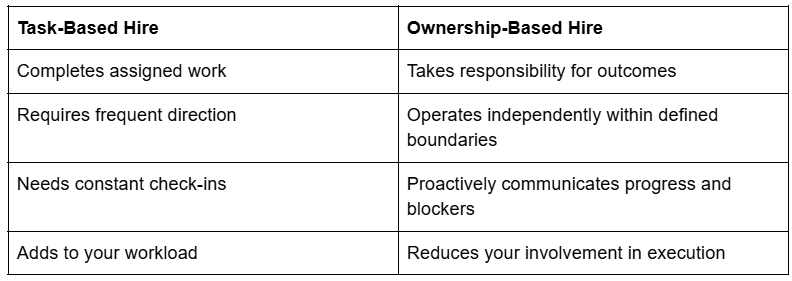
Most companies hire for tasks. What they actually need are people who own outcomes.
This misalignment is especially costly in roles like:
- Virtual Assistants and Executive Assistants managing schedules, communications, and workflows
- Operations and Project Managers driving initiatives from strategy to execution
- Chief of Staff roles that require cross-functional judgment, not just task completion
When these roles are filled by task-oriented candidates — or when expectations aren't clearly set — the result is a founder who becomes the bottleneck for every decision, no matter how small.
What Does It Actually Cost to Replace a Remote Role?
When a remote hire doesn't work out, here's a realistic breakdown of what U.S. companies typically spend to fill that role again:
Direct Costs
- Job posting and advertising: $500–$2,000+
- Recruiter or staffing agency fees: 15–25% of first-year salary
- Interview and assessment time: 10–20 hours of internal HR and manager hours
- Onboarding and training: 4–8 weeks of partial productivity from trainers and managers
Indirect Costs
- Lost productivity during vacancy: often 50–100% of the role's monthly output
- Rework from the failed hire: time spent correcting errors, restarting projects, or repairing client relationships
- Team disruption: reduced morale and increased workload for remaining members
- Delayed initiatives: projects that were counting on that role simply don't happen
For a mid-level remote operations role at $50,000/year, total replacement costs can easily reach $25,000–$75,000 when all factors are accounted for. For senior roles, that number climbs significantly higher.
Why LATAM Talent Is Changing the Remote Hiring Equation
One of the most significant shifts in remote hiring strategy for U.S. companies has been the rise of Latin American professionals as a primary source of skilled remote talent.
Time zone alignment. Unlike offshore hiring from Southeast Asia or Eastern Europe, LATAM professionals typically operate within 1–3 hours of U.S. time zones. This means real-time collaboration, faster decision cycles, and fewer communication gaps — all of which directly reduce the risk of misalignment.
Cultural compatibility. LATAM professionals often bring strong familiarity with U.S. business culture, communication norms, and work expectations — particularly those with prior experience in North American-facing roles. This reduces the cultural friction that can silently undermine remote team performance.
Talent depth. From virtual and executive assistants to marketing specialists, operations managers, and finance professionals, the LATAM talent pool is deep, diverse, and growing. Companies that tap into it strategically — rather than reactively — build remote teams that scale.
The Stages of Remote Hiring That Reduce Risk the Most
Not all parts of the hiring process carry equal weight when it comes to preventing costly mistakes.
1. Role Definition (Before You Post Anything)
This is where most hiring processes fail before they even begin. If you can't clearly articulate what outcomes this person is responsible for, what decisions they can make independently, and what success looks like at 30, 60, and 90 days — you're not ready to hire. You're ready to disappoint someone.
Define the role around outcomes, not tasks. This single step eliminates a significant percentage of misalignment-driven bad hires.
2. Structured Skills Assessment
Resumes and interviews reveal personality. Skills assessments reveal capability. For remote roles, use real-world task simulations that mirror actual work. This filters out candidates who interview well but can't execute independently.
3. Communication and Ownership Fit
For remote teams, communication is the work. Evaluate candidates on how they write asynchronously, whether they flag issues proactively, and whether they use ownership language ("I'll handle it") versus dependency language ("let me know what you need"). These signals are more predictive of remote success than technical skills alone.
4. Structured Onboarding with Clear Milestones
The first 90 days are make-or-break. Companies that invest in structured onboarding — with weekly check-ins, documented expectations, and defined milestones — dramatically reduce early attrition and misalignment. Don't assume remote hires will figure it out on their own.
5. Ongoing Performance Frameworks
Remote roles require explicit KPIs and regular review cadences, not informal check-ins. Create psychological safety for remote team members to raise blockers before they become problems.
How Proper Vetting Changes the Outcome
One of the most underestimated levers in remote hiring is pre-hire verification — and most companies skip it entirely.
Beyond the resume and the interview, a qualified remote professional needs to demonstrate:
- Advanced English proficiency — not just conversational, but capable of clear written communication in async environments (B2 level or higher)
- A reliable technical setup — fast and stable internet, a dedicated computer, and a professional workspace
- Full availability and no conflicting commitments — part-time dedication is one of the most common hidden sources of underperformance
- Clean background and verifiable references — remote roles require a higher baseline of trust since you won't have physical visibility into daily work
This is exactly what WeRemoto's VAProCheck process is designed to address. Before any candidate is presented to a client, they go through a multi-step verification that covers English proficiency, internet reliability, hardware setup, workspace setup, availability, and reference and background checks.
For roles where team dynamics and culture fit matter, VAProCheck also includes optional personality assessments — Enneagram, DISC, MBTI, and the Birkman Method — to help hiring managers understand how a candidate will behave in a distributed team, not just whether they have the right skills on paper.
The result: companies that hire through a vetted pipeline don't just reduce mis-hire risk. They reduce the entire cycle of uncertainty that makes remote hiring feel risky in the first place.
Common Mistakes U.S. Companies Make When Hiring Remotely
Even experienced HR teams fall into predictable traps. Here are the most costly ones:
Hiring for rate, not ROI. The lowest-cost candidate is rarely the highest-value hire. Focus on output relative to investment, not the hourly number.
Expecting ownership from task-defined roles. If you hire a virtual assistant but expect an operations manager, you'll be frustrated — and so will they.
Skipping the trial period. A short paid project (1–2 weeks) reveals more about a candidate's remote work style than any interview.
Underinvesting in onboarding. Remote hires don't have hallway conversations or team lunches to absorb company culture. Onboarding has to be intentional and documented.
Ignoring time zone dynamics. Even within LATAM, a 3-hour gap can create friction if not proactively managed through async norms and communication protocols.
The ROI of Getting Remote Hiring Right
When U.S. companies invest in a thoughtful, structured remote hiring process — sourcing vetted LATAM talent through experienced partners — the business impact is measurable:
- Faster execution: projects move without constant founder involvement
- Lower overhead: skilled professionals at a fraction of equivalent U.S. costs
- Scalable operations: the business grows without proportionally increasing leadership workload
- Higher retention: well-matched, well-onboarded hires stay longer — and the replacement cycle stops
Think of it this way: every dollar saved by rushing a remote hire is potentially five dollars lost in rework, replacement, and delayed growth.
Final Thoughts: The Hire You Make Today Shapes the Business You Build Tomorrow
The real cost of a bad remote hire isn't just financial — it's strategic. It's the product that didn't launch, the client who wasn't served, the system that never got built. It's the founder who stayed stuck in execution instead of moving into growth.
Whether you're hiring a virtual assistant to reclaim your calendar, a project manager to own your operations, or a senior hire to run the business day-to-day, the principles are the same: define outcomes clearly, evaluate capability honestly, vet thoroughly, and invest in alignment from day one.
The companies that get this right — especially those leveraging the depth and talent of LATAM professionals — aren't just building remote teams. They're building businesses that scale without them.
Looking to build a high-performing remote team without the risk of a costly mis-hire? WeRemoto's staffing process and VAProCheck verification system are designed to connect U.S. businesses with pre-vetted LATAM professionals — ready to own outcomes, not just complete tasks. Learn how it works →