


There's a question most hiring managers ask at some point, usually when a role has been open for too long: should we have just hired a recruiter from the start?
Or the reverse: did we really need to pay a staffing fee for a role we could have filled ourselves?
The honest answer is: it depends. But "it depends" isn't useful unless you know what it depends on. This article breaks down the real trade-offs between posting a job and working with a recruiter — so you can make the right call before the role is open, not after three months of hoping applications will improve.
What Job Posting Actually Gives You
Posting a job is the most direct path to building a candidate pool. You define the role, publish it where your target candidates spend time, and let the applications come in.
At its best, a job posting gives you:
- Volume and speed. A well-placed post on the right platform can generate dozens of applications within the first 48–72 hours.
- Full control over the process. You set the criteria, review every candidate, and move at your own pace.
- Lower upfront cost. Compared to recruiter fees, job posting is significantly more affordable — especially for roles where you have the internal capacity to screen candidates.
- Direct access to active candidates. People who apply to job posts are actively looking. That intent matters.
Platforms like LinkedIn Jobs, Indeed, and niche job boards let you reach large candidate pools. For remote roles targeting LATAM talent specifically, platforms like WeRemoto connect you with a community of over 100,000 professionals across the region — with plans starting at $49 for a 15-day post and going up to $248 for the Premium plan, which includes 30 days on the site, highlighted placement, distribution across social media channels, and two newsletter sends to the full subscriber base.
The honest limitation: job posting works when your role is clearly defined, your employer brand does some of the heavy lifting, and you have the internal bandwidth to screen, interview, and evaluate candidates. When any of those three conditions are missing, the volume of applications becomes noise rather than signal.
What a Recruiter Actually Gives You
A recruiter — whether an agency, a staffing partner, or an embedded talent professional — takes the search off your plate. They source, screen, and present candidates who have already been evaluated against your requirements.
What you're actually paying for:
- Active sourcing, not passive waiting. Recruiters go find candidates. They're not waiting for someone to click "Apply." This matters enormously for senior roles, niche skill sets, or markets where the best candidates aren't actively job hunting.
- Pre-screening and qualification. The candidates you see have already passed an initial filter. Your time goes into evaluating finalists, not sorting through unqualified applications.
- Market knowledge. A good recruiter knows what the talent market looks like right now — what candidates expect, what competing offers look like, and where the friction points are in your specific role.
- Reduced time-to-fill for hard searches. For specialized or senior roles, a recruiter with an existing network can move significantly faster than an open posting.
The trade-off is cost. Traditional contingency recruiters typically charge 15–25% of the hired candidate's first-year salary. For a $60,000 role, that's $9,000–$15,000. For senior roles, fees climb higher. Retained search arrangements — where you pay a portion of the fee upfront regardless of outcome — are standard for executive-level hiring.
That fee is worth it when the alternative is a role sitting open for 60 or 90 days, costing you in delayed execution, team overload, and lost opportunity. It's less obviously worth it when a well-placed job post would have done the job in three weeks.
The Variables That Actually Determine the Right Choice
The decision isn't really about posting vs. recruiting as philosophies. It comes down to four practical variables.
1. Role complexity and seniority
The more specialized the role, the more valuable active sourcing becomes. An entry-level customer support representative or administrative assistant can typically be filled through a job post — the candidate pool is deep and applicants are plentiful. A Head of Operations or a senior financial analyst with specific industry experience is a different search entirely. The best candidates for that role are probably already employed and not browsing job boards.
2. Internal capacity
Do you have someone who can dedicate 5–10 hours a week to screening, scheduling, and evaluating candidates? If yes, a job post is viable. If your HR team is stretched or this role is outside your usual hiring scope, handing the search to a recruiter makes practical sense — even if you could technically do it yourself.
3. Time pressure
How long can this role stay open? If you have flexibility, a job post gives you time to build a quality pipeline. If this role is blocking a product launch, a client onboarding, or a team's capacity to function, the speed advantage of an active recruiter search often outweighs the cost.
4. How well you know what you're looking for
Job posts require you to write a clear, compelling description of the role and its requirements. If you're hiring for a position you've hired before and know exactly what good looks like, a post works well. If you're creating a new role, entering a new market, or unsure how to frame the requirements — a recruiter who has placed similar roles before can save you from hiring the wrong person even if you find a good candidate.
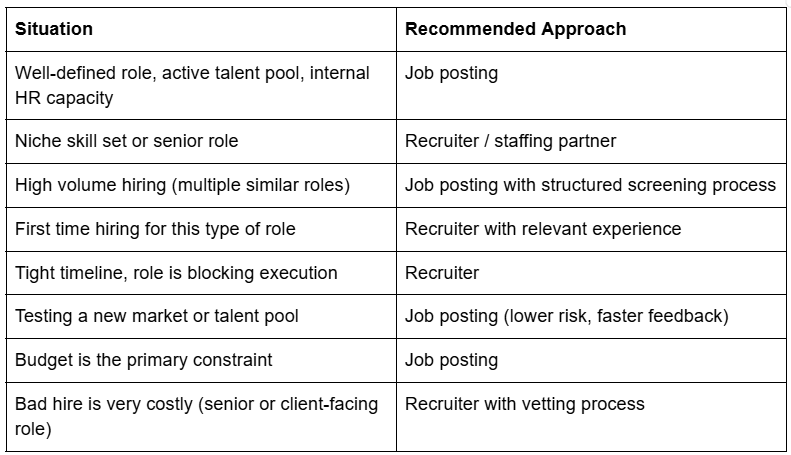
A Practical Decision Framework
How the Calculus Changes When Hiring LATAM Talent Remotely
For U.S. companies hiring remotely across Latin America, both options exist — but each works differently than it does in a domestic market.
Job posting in LATAM gives you access to a very large and growing pool of active candidates. The demand for remote work in the region is high, and professionals actively search platforms that specialize in remote roles. A well-written job post on the right platform — one with an established audience among LATAM remote professionals — can generate strong candidate volume quickly and affordably.
The challenge is that not all platforms reach the same audience. A job post on a general U.S. job board may not perform well for LATAM talent. A post on a platform built specifically for remote-first, LATAM-focused hiring — like WeRemoto — puts your role in front of the right professionals from day one.
Working with a LATAM staffing partner makes more sense when you want the search handled end-to-end, when you need pre-vetted candidates rather than raw applicants, or when the role requires specific expertise that's harder to filter through a job post alone. A staffing partner with regional expertise also understands the nuances of LATAM talent markets that vary significantly by country — what candidates expect, how to evaluate English proficiency, how to assess remote-readiness, and how to structure offers that are competitive in context.
At WeRemoto, both paths are available. You can publish your role directly to our community of 100,000+ LATAM remote professionals through our job posting plans — starting at $49 and scaling up based on distribution reach. Or you can work with our staffing team, who will source, screen, and present pre-vetted candidates through our VAProCheck process — which includes English proficiency verification, background checks, technical setup assessment, and availability confirmation before any candidate is presented to you.
The right choice depends on your role, your timeline, and how much of the process you want to own.
When to Combine Both
There's a third option that experienced hiring teams often use: run both in parallel.
Post the job to generate inbound applications and test the market. Simultaneously engage a recruiter to do active outreach to candidates who aren't applying. This is particularly effective when you need to fill a role quickly, the position is competitive, or you want to benchmark what the candidate market actually looks like before committing to one sourcing strategy.
The overlap also creates useful data. If your job post is generating strong applicants, you may not need the recruiter to run the full search. If it's not, you already have the search underway.
The Bottom Line
Posting a job and hiring with a recruiter aren't competing philosophies — they're tools. And like any tool, the value depends on whether you're using the right one for the job.
Post when the role is well-defined, the talent pool is active, and you have the internal capacity to run a quality screening process. Bring in a recruiter when the role is specialized, the timeline is tight, the cost of a bad hire is high, or you simply don't have bandwidth to own the search.
For companies building remote teams across Latin America, the good news is that both options are more accessible — and more affordable — than most hiring managers expect.
The harder part isn't choosing between them. It's being honest about what your hiring situation actually requires.
Not sure which approach is right for your next hire? WeRemoto offers both paths: self-serve job posting plans starting at $49, and full staffing services for companies that want pre-vetted LATAM talent presented and ready to interview. See job posting plans → or learn about our staffing process →