

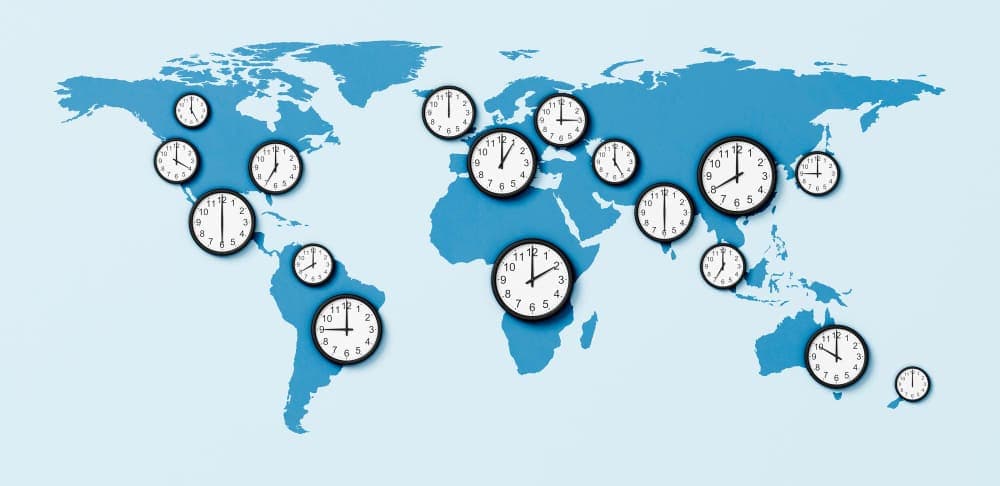
For companies building remote teams, few factors are as critical to success as time zone alignment. Poor overlap means delayed responses, missed meetings, and communication bottlenecks that slow down entire projects. It's one of the most overlooked — yet most impactful — elements of a distributed team strategy.
While many global hiring strategies look toward Eastern Europe or Southeast Asia, HR leaders and hiring managers are increasingly turning their attention to Latin America — and for good reason. LATAM talent offers something rare in the world of remote work: the ability to collaborate with U.S. teams in real time, during the same business day, without the friction of a 10-hour time difference.
In this guide, we break down exactly how Latin American time zones align with U.S. working hours, why that alignment matters for distributed teams, and what HR professionals and companies need to know before building their next remote team in the region.
The Core Advantage: Real-Time Collaboration Without the Wait
When companies hire talent in regions like Asia or Eastern Europe, they often accept a tradeoff: access to skilled professionals, but at the cost of synchronous collaboration. Teams end up leaving asynchronous messages, waiting overnight for responses, and scheduling meetings at inconvenient hours just to get everyone in the same virtual room.
Latin America eliminates that tradeoff.
From Mexico to Argentina, most LATAM countries operate between UTC-6 and UTC-3, creating 6 to 8 hours of daily overlap with U.S. business hours. For HR teams and companies managing distributed workforces, this is a game-changer.
This means LATAM professionals can:
- Attend live standups and sprint reviews
- Respond to Slack messages in real time
- Join client calls without scheduling gymnastics
- Collaborate on shared documents simultaneously
- Participate fully in team culture — not just asynchronously
The result? Remote teams that actually feel like teams.
How Latin American Time Zones Map to the U.S. Workday
Latin America spans four primary time zones. Here's how each region aligns with U.S. working hours — and what that means for companies and HR teams building distributed teams.
🕕 Central America & Mexico — UTC-6 (U.S. Central Time)
Countries include:
- Mexico
- Guatemala
- Costa Rica
- Honduras
- El Salvador
- Nicaragua
These countries operate on the same offset as U.S. Central Time, giving companies based in cities like Austin, Dallas, Chicago, and Houston a near-perfect working hour match. Remote employees in this region can follow an identical 9-to-5 schedule without any adjustment.
For HR teams in Central Time Zone cities, hiring LATAM talent from this region is as seamless as hiring locally — minus the geographic limitations.
🕔 Andean Region — UTC-5 (U.S. Eastern Standard Time)
Countries include:
- Colombia
- Peru
- Ecuador
- Panama
This group operates at UTC-5 year-round, which aligns precisely with U.S. Eastern Standard Time. For companies based in New York, Miami, Boston, or Washington D.C., this is as close to a perfect time zone match as you'll find in any international hiring market.
HR managers hiring from this region can expect their remote employees to be fully available during every hour of the standard U.S. workday — no early mornings, no late-night calls, no scheduling compromises.
🕓 Caribbean & Northern South America — UTC-4
Countries include:
- Dominican Republic
- Puerto Rico
- Bolivia
These countries run one hour ahead of U.S. Eastern Time. The overlap remains strong, with teams sharing most of the core business day. For companies operating on the East Coast, this one-hour difference is rarely disruptive and often goes unnoticed in day-to-day collaboration.
🕒 Southern Cone — UTC-3
Countries include:
- Argentina
- Brazil
- Uruguay
- Chile
The Southern Cone sits two hours ahead of U.S. Eastern Time. Even so, teams in this region still share 6+ hours of daily overlap with U.S. companies — a significant advantage compared to hiring in Asia or Eastern Europe, where time differences can reach 8 to 12 hours.
For companies that prioritize morning collaboration, Southern Cone talent can actually be an asset — professionals are already well into their workday when U.S. East Coast teams are just getting started.
Why Time Zone Overlap Is a Strategic Priority for HR Teams
For HR leaders and people operations teams managing distributed workforces, time zone alignment isn't just a scheduling convenience — it's a strategic decision that affects productivity, culture, and retention.
Here's what synchronous collaboration enables that asynchronous workflows simply can't replicate:
✅ Faster Problem-Solving
When teams share working hours, blockers get resolved in minutes rather than days. A developer in Bogotá can ask a question and receive an answer from their U.S.-based manager before lunch — not the following morning.
✅ Stronger Team Integration
Remote employees who participate in live meetings, real-time brainstorms, and spontaneous conversations develop a stronger sense of belonging. This directly impacts engagement and reduces turnover — two metrics every HR team watches closely.
✅ Shorter Feedback Loops
Projects move faster when reviews, approvals, and decisions happen within the same business day. For companies in fast-moving industries like tech, marketing, or e-commerce, this speed is a competitive advantage.
✅ Simplified Management
Managing a team across a 12-hour time difference requires elaborate systems, asynchronous documentation, and significant process overhead. Managing a team across 1–2 hours is straightforward — and far less taxing on managers and HR teams.
Beyond Time Zones: Why LATAM Talent Is a Top Choice for U.S. Companies
Time zone alignment is the foundation, but it's not the only reason empresas across the U.S. are building remote teams in Latin America. Here's what else makes the region stand out.
1. Strong English Proficiency
Across the region — particularly in tech, marketing, design, and customer support — professionals regularly work with international companies and communicate fluently in English. HR teams can hire confidently without language barriers becoming a bottleneck.
2. Cultural Compatibility with U.S. Work Styles
LATAM professionals are widely recognized for their direct communication, collaborative mindset, and familiarity with U.S. business practices. This cultural alignment shortens onboarding timelines and reduces the friction that often comes with cross-cultural team building.
For recursos humanos teams managing remote onboarding, this compatibility is invaluable.
3. A Rapidly Growing, Highly Skilled Talent Pool
Latin America has emerged as one of the world's fastest-growing hubs for remote professionals. Companies can access deep talent pools in:
- Software development and engineering
- Digital marketing and content
- Design and creative production
- Operations and project management
- Customer success and support
- Virtual assistance and executive support
Startups and enterprise companies alike are tapping into this pool to scale their distributed teams faster than traditional local hiring allows.
4. Competitive Compensation That Supports Sustainable Growth
Hiring LATAM talent allows companies to access highly skilled professionals at globally competitive rates. While compensation should always reflect experience, value, and market standards, many companies find they can build stronger, more diverse teams while maintaining healthy hiring budgets.
The Real Challenge: Finding and Vetting the Right Talent
Despite all of these advantages, many HR teams and companies still struggle with the practical side of hiring in Latin America:
- Sourcing qualified candidates in unfamiliar markets
- Evaluating remote work readiness beyond technical skills
- Navigating cross-border hiring logistics
- Managing recruitment processes across different countries and legal frameworks
These challenges are real — but they're solvable with the right partner.
How Weremoto Helps Companies Build Remote Teams in LATAM
At Weremoto, we specialize in helping U.S. companies find, vet, and hire top remote talent across Latin America. Our team understands both sides of the equation: the expectations of global companies and the strengths that LATAM professionals bring to distributed teams.
We support HR teams and companies through every stage of the remote hiring process:
- Sourcing remote-ready candidates across LATAM markets
- Screening and vetting talent for technical skills and remote work capability
- Managing the recruitment process so your team can focus on building, not searching
- Supporting integration to help new hires become productive team members quickly
Instead of spending months navigating an unfamiliar hiring market, companies can connect quickly with professionals who are already experienced in working with international remote teams.
Final Thoughts: The Future of Remote Hiring Is Nearshore
As remote work matures, companies are becoming more sophisticated about where they hire — not just who they hire. Time zone alignment, cultural compatibility, and talent quality all factor into that decision.
For U.S.-based companies and HR teams building distributed teams, Latin America checks every box.
With 6–8 hours of daily overlap with U.S. working hours, a growing pool of skilled professionals, strong English proficiency, and genuine cultural alignment, LATAM talent integrates into U.S. teams more seamlessly than almost any other global region.
The future of global hiring isn't offshore — it's nearshore. And Latin America is at the center of that shift.
Ready to build your remote team in Latin America? Connect with Weremoto and start hiring LATAM talent that works in sync with your team.