

There's a complaint that comes up constantly among owners who hired a virtual assistant: "They do exactly what I say and nothing more. I wanted someone who takes ownership."
Here's the uncomfortable part: go back and read the job post that hire came from. It almost always describes a task-doer. "Manage calendar. Answer emails. Data entry. Book travel." The post asked for hands, and hands applied. The disappointment was written into the listing.
After watching thousands of listings perform on our board, the pattern is clear enough to turn into rules.
Rule 1: Describe outcomes you'll own, not tasks you'll assign
Weak listings enumerate activities. Strong listings assign territory.
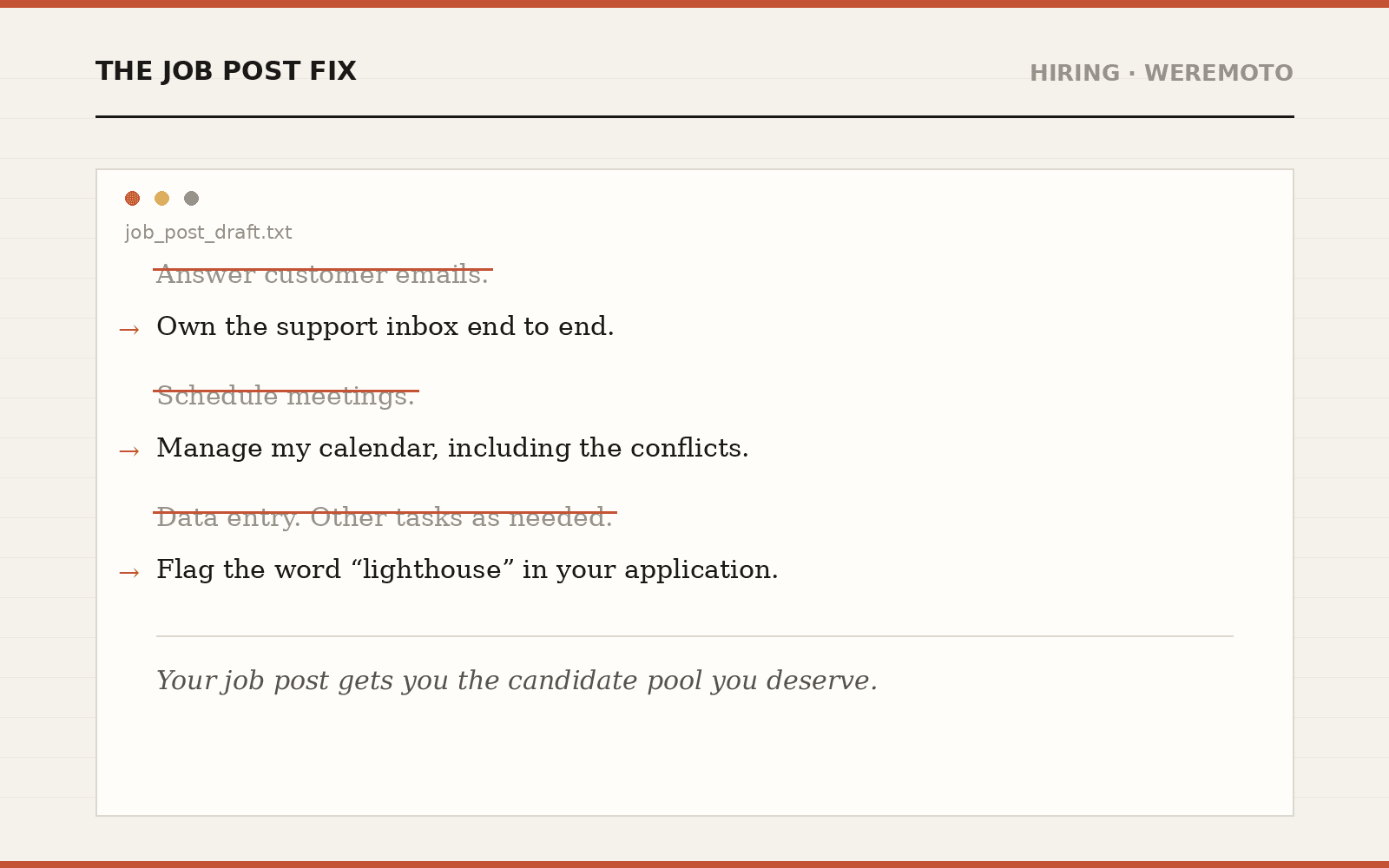
Task language: "Answer customer emails." Ownership language: "Own the support inbox end to end: triage, respond, escalate what truly needs me, and keep response time under 4 hours."
Task language: "Schedule meetings." Ownership language: "Manage my calendar including the conflicts: reschedule, negotiate times with other assistants, and protect two focus blocks per week without asking."
The difference isn't cosmetic. Candidates self-select. People who want to be told what to do skip ownership language because it sounds like pressure. People with judgment lean in because it sounds like trust. Your job post is your first filter, and most owners point it in the wrong direction.
Rule 2: Don't mix the piles
Most listings are a grab bag: strategic support, plus data entry, plus social media, plus "other tasks as needed." Mixed listings attract nobody well. The experienced candidate reads the data entry lines and assumes the role is junior. The junior candidate reads the ownership lines and applies anyway.
Decide what the role actually is. If 80% is judgment work (inbox, clients, coordination), write the post around that and mention the routine work as a footnote. If 80% is routine production, say so honestly and pay accordingly. Two clean listings for two different people beat one confused listing for a unicorn.
Rule 3: State the hours and the overlap, precisely
"Flexible hours" reads as "undefined expectations," and strong candidates have learned to avoid it. Say what's real: "Part-time, 20 hrs/week, at least 4 hours overlapping with US Eastern mornings." Precision signals that you've thought about the role, which signals that working for you won't be chaos. It also lets time-zone-compatible candidates (all of Latin America, for US companies) recognize the fit immediately.
Rule 4: Name the tools, including AI
List your actual stack: the CRM, Slack or Teams, Notion or ClickUp, and whether you expect comfort with AI tools for drafting and research. In 2026, "uses AI tools well" appears in listings for admin and support roles routinely, and it's a genuinely useful filter in both directions: it attracts candidates who work at modern speed and warns off those pretending the last few years didn't happen.
Rule 5: Put a small instruction inside the post
End with something like: "Start your application with the word 'lighthouse' and tell us about one process you improved without being asked."
Two filters in one line. The keyword instantly reveals who actually read the post (expect to discard half your applications on this alone, which is the point). And the question forces a specific story about initiative, which is the exact quality you're hiring for and the hardest one to interview for.
The meta-rule
Your job post gets you the candidate pool you deserve. Vague post, vague applicants. Task list, task-doers. If you want someone who treats your business with care and initiative, the first demonstration of care and initiative has to be yours.
Related reading:
→ How to Create and Evaluate Remote Job Roles to Attract the Right LATAM Talent
→ 10 Hiring Trends Shaping 2026 (And How to Adapt Fast)
→ Why Small Businesses and Entrepreneurs Should Hire a Virtual Assistant