

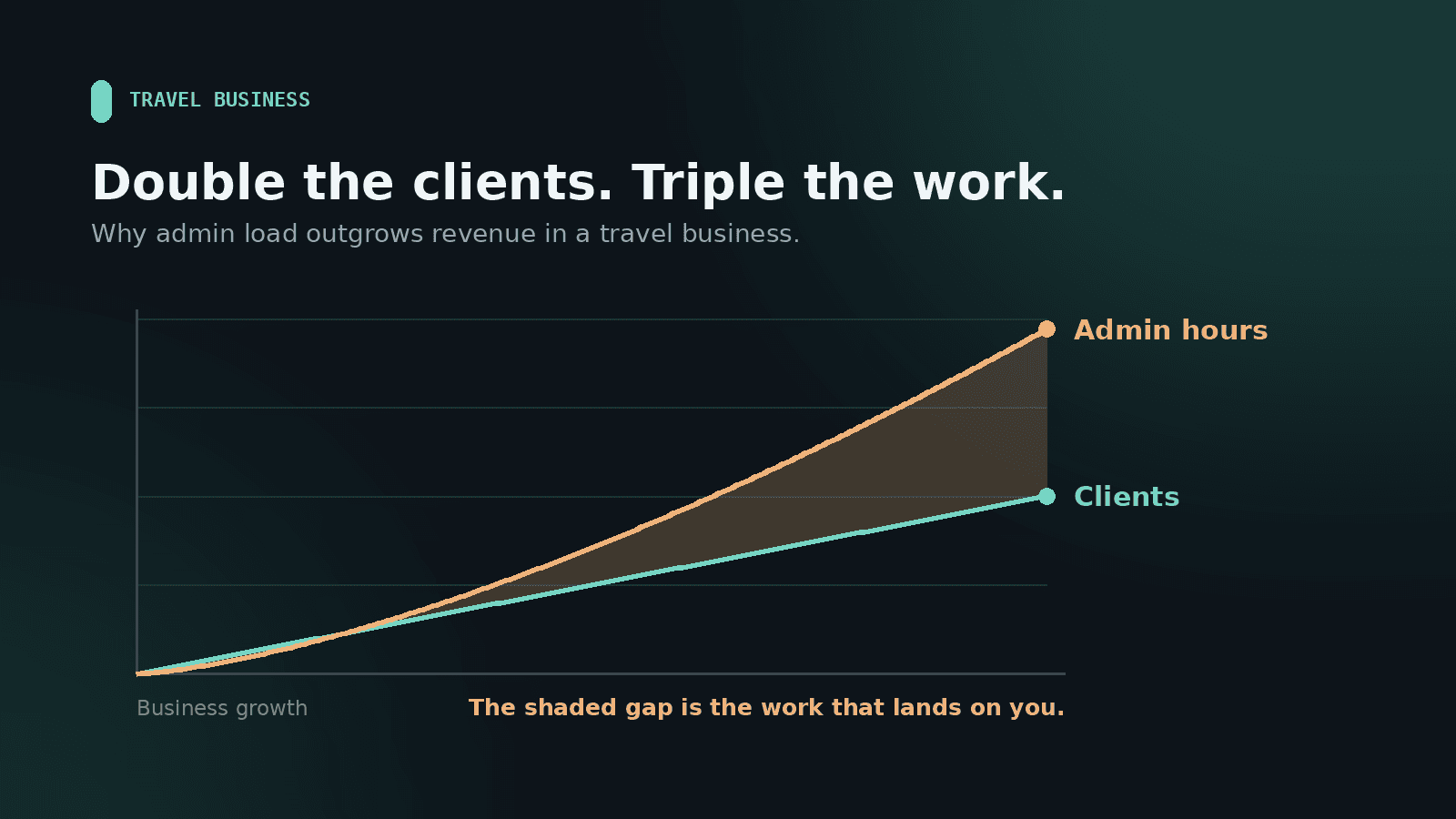
The challenges of scaling a travel business come down to five things: the admin load grows faster than the revenue, peak weeks break every system you have, you become the bottleneck for every decision, growth starts costing you the client relationships you built the business on, and hiring feels risky enough that you keep putting it off. None of them are signs you are doing it wrong. They are what happens when a business built around one person's expertise starts outgrowing one person's hours.
If you pictured year three as the one where things finally calm down, the good news is that the work changes. The less good news is that it does not get lighter on its own.
Published September 2026.
Passion got you here. It will not get you to the next part.
You built this on taste, relationships, and being the person who actually cares whether the transfer shows up. That is not replaceable and it is why clients keep coming back.
But the thing that made you good at year one is not the thing that makes year four sustainable. At some point the business stops being a question of whether you can design a great trip and starts being a question of how many great trips you can design before the coordination eats the week.
That shift catches most advisors off guard, because nothing about it feels like progress while it is happening.
Challenge #1: Admin grows faster than revenue
Double your clients and you have not doubled your work. You have roughly tripled it.
Every booking carries a tail: confirmations, follow-ups on the confirmations, itinerary documents, changes to the itinerary documents, payment reminders, supplier chasing, data entered into three systems that do not talk to each other.
That tail does not scale with your skill. It scales with volume, and it lands on the same person.
The fix is not working faster. It is separating the work that requires your judgment from the work that requires someone's attention, and being honest that the second category is most of your calendar.
Challenge #2: Peak weeks break everything
Your systems work fine in an ordinary month. Then a large group departs, three clients travel the same week, and everything you built for a normal workload stops holding.
This is the point where advisors discover that their processes were never really processes, they were just habits that worked at low volume.
The advisors who get through peak weeks well are not the ones working the hardest. They are the ones who decided in advance what happens when a flight changes at 6am: who tracks it, who updates the document, who calls the client, and who is allowed to make the call without asking.
That decision is worth making on a quiet Tuesday, not during the week it matters.
Challenge #3: You become the bottleneck
At some point every question routes through you. Not because you want control, but because you are the only one who knows the answer.
This is where growth stops feeling exciting and starts feeling like a trap. You cannot take a week off. You check email on holiday. You are answering a supplier question from a restaurant.
The uncomfortable truth here: the bottleneck is usually made of things you never wrote down. Not the strategy, the small stuff. Which supplier you use for transfers in Lisbon. What you always include in a welcome packet. How you handle a client who goes quiet after the proposal.
Documenting that feels like a low priority for years, right up until it becomes the only thing standing between you and time off.
Challenge #4: Growth costs you the relationships
The reason clients pay you a premium is that you are paying attention. More clients means less attention per client, unless something changes.
This is the challenge that actually threatens the business, and it is the one nobody talks about, because the numbers look great right up until a long-standing client quietly books elsewhere.
The advisors who avoid it protect the relationship work above everything else. They will let a document go out a day later. They will not shorten the call where they figure out what a client actually wants.
Protecting that means someone else has to absorb the rest. There is no version where you personally handle both and the quality holds.
Challenge #5: Hiring feels riskier than staying overwhelmed
So most advisors wait too long.
The hesitation is reasonable. Nobody else knows your suppliers, your standards, or the way you like an itinerary to read. Training someone takes hours you do not have. And the first month is a cost, not a gain.
But the thing that makes hiring fail is almost never the person. It is starting without knowing what they will actually do.
If you cannot describe what this person would work on next Tuesday, the hire will not work, no matter how good they are. The fastest way to find out: spend one week writing down everything you touch and how long it took. At the end of the week you will have your answer, and it will not be the list you would have guessed.
Is scaling a travel business worth it?
For advisors who want to build something beyond their own capacity, yes. The business gets more interesting as it grows, not less, as long as you protect the part that made it work.
The five challenges above are not warnings. They are what the road looks like, and every advisor with a real business has walked it.
What changes the outcome is deciding early which work is yours and which work simply has to happen. The first category is the reason clients hire you. The second is the reason your evenings disappear.
Where remote support fits
Most of what fills a travel advisor's week is coordination, documentation, research and administration. All four are delegable, and all four are what remote travel coordinators and assistants do.
Two things matter when the support is remote in this industry. The first is time zone: travel breaks in real time, and support that is eleven hours ahead turns every question into a next-day question. Latin America sits zero to two hours from US eastern time, which is the practical reason it works here. The second is the tools. Someone who already knows TripIt, TravelJoy and the supplier portals is not learning your business and the software at the same time.
What stays with you is the part clients are actually paying for: the relationship, the design judgment, the supplier connections you built, and the call when something goes wrong.
Thinking about what that would cover in your business? See how WeRemoto staffs travel advisors, or read how we vet every candidate before you see a single resume.